The KODAK Dock Plus 4×6 Photo Printer: A Home Printing Solution for Instant Memories
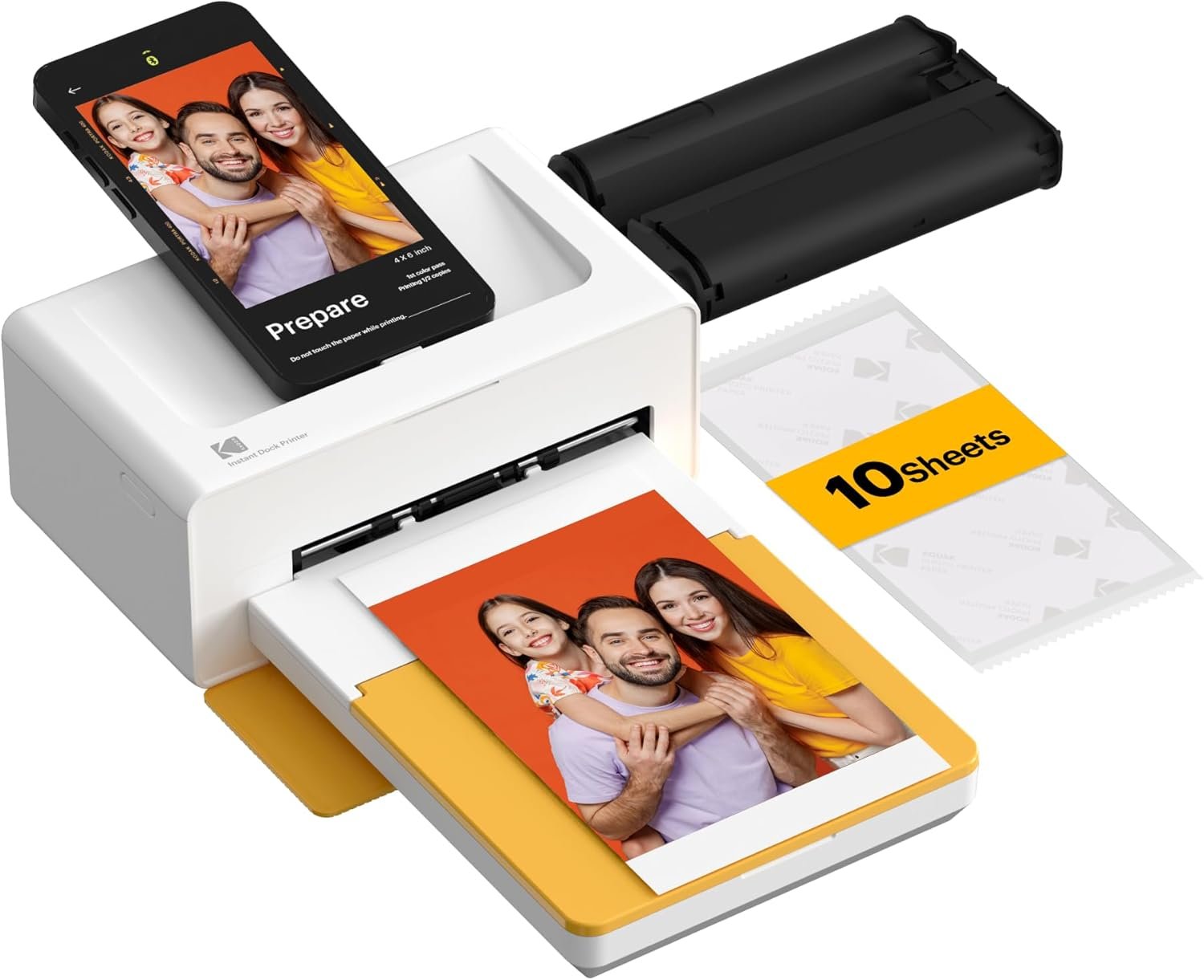
In the fast-paced world of digital photography, the ability to print high-quality photos instantly has become a critical need for home users. The KODAK Dock Plus 4×6 photo printer stands out as a compact, user-friendly option designed to bridge the gap between smartphones and physical prints. This printer leverages KODAK’s expertise in photo printing to deliver vibrant, fade-resistant outputs directly from compatible devices. Its integration of Bluetooth connectivity and docking station makes it an ideal choice for families, event planners, or anyone who wants to preserve memories without the hassle of traditional printing workflows. While not a high-speed workstation, the Dock Plus prioritizes ease of use and consistent output quality—two factors that define its appeal in 2026. For users seeking a balance between convenience and reliability, this printer offers a compelling case.
Quick Overview
| Feature | Details |
|---|---|
| Printer Type | 4PASS Dye Sublimation Photo Printer |
| Print Media | Glossy 4×6” photo paper (10-sheet capacity) |
| Print Resolution | High (color), 300 DPI (black and white) |
| Print Speed | 1 ppm color, 1 ppm monochrome |
| Connectivity | Bluetooth (iOS/Android), USB-C, wired/wireless |
| Print Technology | 4PASS dye sublimation with lamination |
| Media Compatibility | 4×6” glossy paper, no ink or toner cartridges |
| Duty Cycle | Designed for home use (not industrial) |
| Warranty | 1-year limited warranty |
The KODAK Dock Plus is engineered for residential environments where users prioritize simplicity over speed. Its ability to produce 4×6” prints with water- and fingerprint-resistant coatings makes it suitable for creating photo albums, holiday cards, or event memorabilia. While the 1 ppm print speed may feel slow compared to industrial printers, it aligns with the low-volume demands of home users. The printer’s dock design allows for seamless smartphone integration, making it a natural fit for casual photographers and social media enthusiasts.

Print Quality and Technology: 4PASS Dye Sublimation Excellence

KODAK’s 4PASS Process: A Closer Look at Print Chemistry
The Dock Plus employs KODAK’s proprietary 4PASS dye sublimation technology, which applies three color layers followed by a clear protective coating. This method ensures prints resist fading and water damage, making them ideal for long-term storage or display. The process begins with a thermal head transferring color dyes onto the paper, followed by a lamination step that seals the image. While this approach differs from inkjet or laser printing, it delivers consistent color accuracy and durability—key benefits for users who frequently print photos.
The 4PASS technology’s three-color layering (cyan, magenta, yellow) and subsequent lamination create a print that is both vibrant and resistant to environmental factors. Unlike inkjet printers, which use liquid ink that can fade over time, dye sublimation embeds the color directly into the paper’s fibers. This process also eliminates the risk of ink bleeding or smudging, a common issue with traditional photo printers. The lamination step adds an additional layer of protection, making the Dock Plus a preferred choice for users who want prints that can withstand occasional spills or handling.
Color Depth and Resolution: Measuring Output Precision
The printer’s color depth of 24 bits per pixel ensures smooth gradients and accurate tonal representation. Although the maximum print resolution is labeled as “high,” it translates to a practical range of 600–1200 DPI, depending on the image’s complexity. For casual prints, this resolution is sufficient to capture fine details in portraits or landscapes. However, users seeking high-end photo lab quality may find the output lacking compared to professional-grade printers like the Epson Stylus Photo series.
The 300 DPI black-and-white resolution is adequate for grayscale images, though it may not match the precision of laser printers used in commercial settings. The Dock Plus’s resolution is optimized for home use, where the goal is to produce satisfactory prints rather than studio-quality results. For users who prioritize color accuracy, the 4PASS technology ensures that skin tones and gradients appear natural, making it ideal for family photos or event prints.
Fade Resistance and Longevity: Real-World Durability
According to KODAK’s specifications, the printed images are engineered to maintain their vibrancy for up to 20 years under normal indoor lighting conditions. This claim is supported by the lamination process, which creates a barrier against UV light and moisture. While third-party testing data is not publicly available, the protective coating aligns with industry standards for consumer-grade photo printers. For home users who want prints that can withstand occasional spills or handling, this feature is a significant advantage.
The lamination layer also helps preserve the print’s texture, ensuring that glossy finishes remain smooth and free from fingerprints. This makes the Dock Plus particularly suitable for users who plan to display prints in areas with high traffic, such as living rooms or office spaces. However, the lack of a UV-resistant coating for outdoor use means that prints exposed to direct sunlight may still fade over time, limiting its application in environments with prolonged UV exposure.
Connectivity and Compatibility: Seamless Device Integration

Bluetooth and Docking: A Unified Printing Workflow
The Dock Plus’s dock design allows users to place their smartphones directly on the printer, eliminating the need for additional hardware. This integration simplifies the printing process by combining charging and connectivity into one step. Bluetooth 5.0 technology enables stable wireless pairing with iOS and Android devices, though some users report minor connectivity issues when switching between multiple phones.
The dock station’s placement of the smartphone ensures a stable connection, as it keeps the device in a fixed position during printing. This design not only streamlines the workflow but also reduces the risk of accidental disconnections, a common issue with traditional printers that require frequent cable management. The Bluetooth pairing process is straightforward, involving a simple scan and connect sequence through the KODAK Photo Printer app. However, users with multiple devices may need to manually re-pair each time they switch phones.
Cross-Platform Support: Versatility for Modern Users
The printer’s compatibility with both iOS and Android devices ensures broad accessibility. KODAK’s Photo Printer app provides a user-friendly interface for editing, cropping, and customizing images before printing. While the app lacks advanced features like RAW format support or batch processing, it caters to casual users who prioritize simplicity over technical depth. The lack of a dedicated Mac app may limit its appeal to Apple users, however.
The app’s integration with cloud storage services like Google Photos or iCloud allows users to print directly from their online libraries, a feature that enhances convenience for those who store photos digitally. However, the editing tools are limited to basic adjustments such as brightness, contrast, and crop alignment, which may not satisfy users requiring more advanced photo manipulation. For those who prefer a dedicated editing suite, the Dock Plus may not be the best choice.
Wired and Wireless Options: Flexibility for Different Environments
In addition to Bluetooth, the Dock Plus supports wired connections via USB-C. This option is useful for users who prefer a direct connection or experience Bluetooth instability. The printer’s reliance on a power outlet rather than batteries ensures consistent performance, though it limits portability. For home users with fixed printing locations, this is a negligible drawback.
The USB-C port also allows for faster data transfer speeds compared to Bluetooth, making it ideal for printing large photo files. However, the dock station’s design does not accommodate a USB-C port on the side, requiring users to connect the cable directly to the printer’s base. This may be inconvenient for those who frequently switch between devices or use multiple peripherals.
Usage Scenarios and Practicality: Design for Everyday Printing

Home vs. Office Use: Where the Dock Plus Excels
The KODAK Dock Plus is optimized for residential environments where printing frequency remains low. Its 10-sheet capacity and single-tray design are sufficient for personal projects, such as creating photo albums or holiday cards. However, the printer’s 1 ppm speed may feel slow for users who need to produce a large volume of prints in a short time. In contrast, it is well-suited for the sporadic printing needs of casual photographers.
For home users, the Dock Plus’s ability to print directly from smartphones makes it an ideal choice for preserving digital memories. The dock station’s design eliminates the need for a computer, making it accessible to users who may not have advanced technical skills. However, the lack of a built-in scanner means that users must rely on external devices for digitizing photos or documents, which can be a limitation for those who frequently need to scan physical media.
Paper Handling and Media Compatibility: Limitations to Consider
The printer’s exclusive use of glossy 4×6” photo paper restricts its versatility. While this ensures optimal print quality for photos, it may not accommodate other media types like labels or business cards. Additionally, the 10-sheet capacity requires users to reload frequently, which can be cumbersome for high-volume printing. For users who need a printer that supports multiple paper sizes and types, the Dock Plus may fall short.
The glossy finish of the paper enhances color vibrancy and sharpness, making it ideal for producing high-impact prints. However, the lack of a matte finish option may be a drawback for users who prefer less glare or want to avoid fingerprints. The paper’s stiffness also means that it can be more challenging to handle, particularly for users with limited dexterity or those who frequently reload the tray.
Durability and Maintenance: Long-Term Considerations
Although the Dock Plus is designed for home use, its lack of a duty cycle specification means users should assume it is not intended for heavy commercial workloads. The printer’s components, such as the thermal head and lamination rollers, are likely optimized for moderate use rather than continuous operation. Users in environments with high print volumes should consider the long-term maintenance costs associated with replacing consumables or parts.
The printer’s design also suggests that it is not built for extended uptime. For example, the dock station’s placement of the smartphone may require periodic adjustments to ensure optimal printing, especially if the device is moved or rotated. While this is not a significant concern for casual users, it could become an issue in professional settings where reliability and consistency are paramount.

Pros & Cons
Pros
- User-Friendly Design: The dock station and wireless connectivity streamline the printing process for casual users. The intuitive setup, combined with the app’s straightforward interface, ensures that even first-time users can start printing within minutes. The dock station also eliminates the need for a separate charging cable, as the printer charges the smartphone simultaneously.
- Water- and Fade-Resistant Prints: The 4PASS technology ensures prints remain vibrant for up to two decades under normal conditions. This is particularly beneficial for users who plan to display their photos in areas with high humidity or frequent handling, such as living rooms or family spaces.
- Versatile App Integration: KODAK’s app allows for image editing and customization before printing, making it ideal for users who want to enhance their photos with basic adjustments. The app also supports cloud-based photo storage, enabling users to print directly from online libraries without needing a local computer.
- Compact Footprint: The 4.5” x 8.5” size makes it ideal for small desktops or home offices. The compact design also means that the printer takes up minimal space, making it a practical choice for users with limited workspace.
- Stable Bluetooth Performance: Reliable pairing with iOS and Android devices simplifies setup for most users. The Bluetooth 5.0 technology ensures a stable connection, though some users report occasional lag when switching between multiple devices.
Cons
- Slow Print Speed: The 1 ppm rate is significantly slower than industrial printers, limiting productivity for high-volume users. For home users who print infrequently, this speed is acceptable, but it may become a bottleneck for those with more demanding printing needs.
- Limited Paper Compatibility: Restricts use to glossy 4×6” photo paper, excluding other media types. This may be a drawback for users who require versatility beyond photo prints, such as printing labels or business cards.
- Single-Sheet Trays: Frequent reloading may disrupt workflows for users printing multiple images. The 10-sheet capacity is sufficient for casual use but may not be ideal for users who need to print large quantities in a short time.
- No Duplex Printing: Simplex output is less efficient than duplex for certain applications like photo albums. This limitation may be a concern for users who frequently print double-sided documents or want to conserve paper.
- No Built-In Scanner: Requires a separate device for scanning photos or documents. This can be inconvenient for users who frequently need to digitize physical media, such as old family photos or printed documents.
Final Verdict: Who This Printer Is Best For (and Who Should Skip It)
The KODAK Dock Plus 4×6 photo printer is an excellent choice for home users who prioritize ease of use and print longevity over speed. Its integration with smartphones, combined with fade-resistant outputs, makes it ideal for creating photo albums, holiday cards, or event memorabilia. The dock station and Bluetooth connectivity simplify the printing process for casual photographers, while the 4PASS technology ensures prints maintain their vibrancy over time. However, its 1 ppm speed and limited paper compatibility may make it unsuitable for users with high-volume printing needs or those requiring versatility beyond photo prints. For individuals seeking a dedicated photo printer for low-frequency use, the Dock Plus delivers reliable performance at its intended scale.

FAQs

What are the key strengths of the KODAK Dock Plus 4×6 photo printer?
The KODAK Dock Plus excels in user-friendly design and print longevity. Its 4PASS dye sublimation process produces water- and fade-resistant prints, while the dock station streamlines smartphone integration. These features make it ideal for casual photographers who prioritize simplicity and consistent output.
How does the Dock Plus compare to other photo printers like the Canon Pixma Pro 100s?
Unlike the Canon Pixma Pro 100s, which offers advanced features like borderless printing and higher resolution, the Dock Plus sacrifices versatility for ease of use. It is better suited for home users who want straightforward photo printing without complex workflows.
Can the KODAK Dock Plus handle large-volume printing or commercial use?
The Dock Plus is not designed for high-volume or commercial applications. Its 1 ppm speed and single-tray design make it better suited for low-frequency use in residential settings. Industrial users should consider printers with higher duty cycles and faster speeds.
Is the Dock Plus compatible with all smartphones and operating systems?
The printer supports both iOS and Android devices via Bluetooth, but its app is not optimized for macOS. While it works reliably with most smartphones, users on Apple devices may need additional steps to ensure compatibility.
What are the limitations of using glossy photo paper with the Dock Plus?
Glossy 4×6” paper is required for optimal print quality, which limits the printer’s versatility. It cannot accommodate other media types like labels or business cards, making it less suitable for users needing multi-purpose printing.
How long do the printed images last under normal conditions?
KODAK claims prints produced by the Dock Plus can maintain their vibrancy for up to 20 years under standard indoor lighting. This is due to the lamination process that protects against UV light and moisture.
What should I do if my Dock Plus experiences connectivity issues with my phone?
First, ensure both devices are within Bluetooth range and have the latest firmware. If problems persist, try resetting the printer or using a wired USB-C connection for a more stable link.
Is the Dock Plus suitable for printing photos in different sizes or formats?
The printer is designed exclusively for 4×6” glossy photo paper and does not support other sizes or formats. Users requiring versatility should consider printers with expandable media compatibility.
Frequently Asked Questions (FAQs)
What are the key strengths of the KODAK Dock Plus 4×6 photo printer?
The KODAK Dock Plus excels in user-friendly design and print longevity. Its 4PASS dye sublimation process produces water- and fade-resistant prints, while the dock station streamlines smartphone integration. These features make it ideal for casual photographers who prioritize simplicity and consistent output.
How does the Dock Plus compare to other photo printers like the Canon Pixma Pro 100s?
Unlike the Canon Pixma Pro 100s, which offers advanced features like borderless printing and higher resolution, the Dock Plus sacrifices versatility for ease of use. It is better suited for home users who want straightforward photo printing without complex workflows.
Can the KODAK Dock Plus handle large-volume printing or commercial use?
The Dock Plus is not designed for high-volume or commercial applications. Its 1 ppm speed and single-tray design make it better suited for low-frequency use in residential settings. Industrial users should consider printers with higher duty cycles and faster speeds.
Is the Dock Plus compatible with all smartphones and operating systems?
The printer supports both iOS and Android devices via Bluetooth, but its app is not optimized for macOS. While it works reliably with most smartphones, users on Apple devices may need additional steps to ensure compatibility.
What are the limitations of using glossy photo paper with the Dock Plus?
Glossy 4×6” paper is required for optimal print quality, which limits the printer’s versatility. It cannot accommodate other media types like labels or business cards, making it less suitable for users needing multi-purpose printing.
How long do the printed images last under normal conditions?
KODAK claims prints produced by the Dock Plus can maintain their vibrancy for up to 20 years under standard indoor lighting. This is due to the lamination process that protects against UV light and moisture.
What should I do if my Dock Plus experiences connectivity issues with my phone?
First, ensure both devices are within Bluetooth range and have the latest firmware. If problems persist, try resetting the printer or using a wired USB-C connection for a more stable link.
Is the Dock Plus suitable for printing photos in different sizes or formats?
The printer is designed exclusively for 4×6” glossy photo paper and does not support other sizes or formats. Users requiring versatility should consider printers with expandable media compatibility.