
Inkjet Printers: What 126 Spec Sheets Actually Say
13 of the 126 products Amazon files as inkjet printers are handheld coders, one listing states 99 pages per minute, and one ink tank model is listed three times with different resolutions and trays.
What we analysed, and how
This report covers every inkjet and ink tank printer our site has reviewed and kept: 126 products, sorted into the class by the printing technology Amazon states, not by the category the review was filed under. They are not all the printer a shopper pictures. 13 are handheld coding printers that mark cartons and 11 are wide-format machines, and both are in the class because Amazon files them as inkjets; the rest of this report is about the 102 desktop printers, 30 of them refillable ink tank models and 72 cartridge models. Each has two independent transcriptions of the listing, our review’s table and Amazon’s detail page, and a figure is called agreed only when both state it and match.
| Inkjet printers | Count | Notes |
|---|---|---|
| Reviewed and kept | 126 | 102 desktop, 13 handheld, 11 wide-format |
| Ink tank models (desktop) | 30 | 29 percent |
| Cartridge models (desktop) | 72 | 71 percent |
| State a black-and-white speed | 97 | 95 percent of desktop |
| State a colour speed | 91 | 89 percent of desktop |
| Print duplex automatically | 68 | 67 percent of desktop |
| Have Wi-Fi | 85 | 83 percent of desktop |
| Are all-in-one machines | 38 | 37 percent of desktop |
Speed: ten pages per minute, and one that is ninety-nine
97 desktop printers state a black-and-white speed, from 1 to 99, a median of 13, and the pile-up is at 10: 21 state exactly 10. The ink tank models state a median of 12 and the cartridge models 13. The colour speed is roughly half the black: across the 91 that state both, the black speed is a median of 1.7 times the colour one.
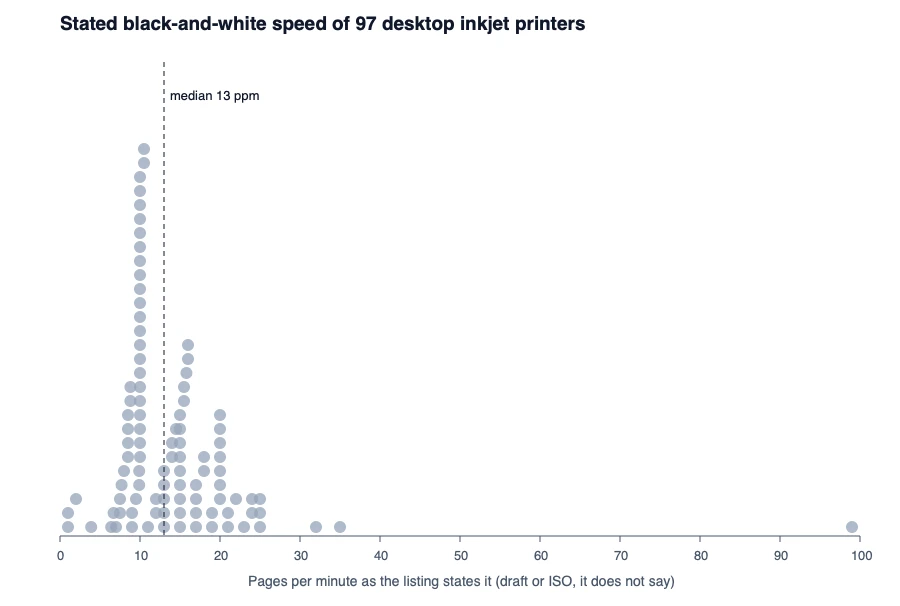
The outlier is an HP OfficeJet Pro 8138e whose Amazon field states 99 pages per minute, and so does our review table. Two sources agree, and the number contradicts the listing itself: its own bullet says “print up to 20 ppm in black and 10 ppm in color”, and its sister models, the 8135e and 8139e, state 20. It is the clearest case in the catalogue of agreement between sources proving nothing, and it is the reason this report does not rank printers by speed. Of the 87 desktop printers that state a speed in both sources, 6 disagree by more than a page a minute, among them HP OfficeJet Pro 8720 (20 on Amazon, 24 in our review), HP OfficeJet Pro 8139e (10 on Amazon, 20 in our review), Epson Expression Home XP-4205 (10 on Amazon, 12 in our review).
Resolution is the first number of a pair
84 desktop printers state a resolution, and the values are 1,200 (30), 4,800 (25), 600 (12), 5,760 (12), 9,600 (2). The figure is the first of a pair, as on laser printers: HP’s listings give “1200 x 1200” for black and “4800 x 1200” for colour, and the field carries whichever label the listing used. One of our own review tables says that the figure is interpolated, as in “9600 x 2400 dpi interpolated”, which means a software enhancement of a lower physical resolution.
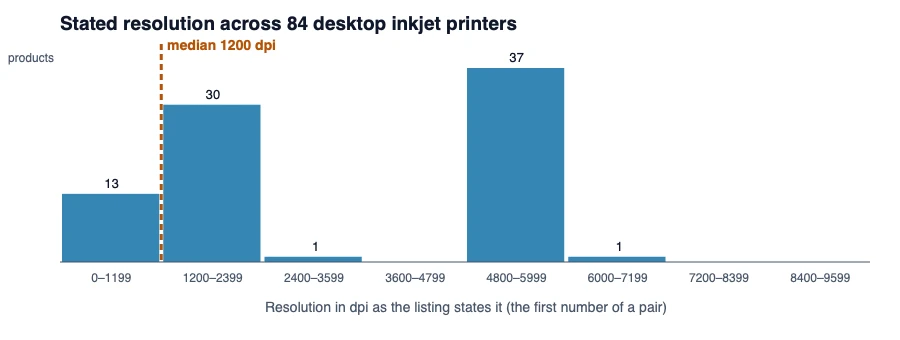
The Epson ET-2800 and HP Smart Tank 5101 page shows two refillable-tank printers of nearly the same weight whose Amazon fields read 5,760 and 1,200: a ratio of nearly five that says nothing about which prints a better page, because the Epson’s is the colour figure and the HP’s the black one.
One model, several sets of figures
Epson ET-2720 is listed 3 times with resolutions of 9,600, 5,760, 5,760 and tray capacities of 3,000, 100, 100; Canon TR4720 is listed 3 times with resolutions of 4,800, none, 4,800 and tray capacities of 100, 200, 100; HP CZ993A is listed 2 times with resolutions of 1,200, 600 and tray capacities of 300, 50. A tray capacity of 3,000 sheets on a home ink tank printer is not a plausible tray. When one product’s listings do not agree with each other, a comparison between listings is a comparison between data entry.
Handheld coders and wide-format machines
The 13 handheld inkjet printers are not what the other 102 are. They are marking devices for boxes and packaging, they state speeds of 5 to 60 “pages” per minute, resolutions of 203 to 600 dpi and trays of 1 to 50 sheets, and 6 in no price band, 3 in $75-200, 2 in $500+. The 11 wide-format machines are a different class again, at 19 kilograms at the median. Neither belongs in a comparison with a home printer, which is why the figures above leave them out.
Tank and cartridge machines compared
The two kinds of desktop printer differ in what they state, as well as in how they are inked. Set against each other, the 30 ink tank models and the 72 cartridge models look like this.
| Desktop inkjet | Ink tank | Cartridge |
|---|---|---|
| Median black speed | 12 ppm | 13 ppm |
| Median weight | 6.4 kg | 6.4 kg |
| Median tray | 100 sheets | 150 sheets |
| Automatic duplex | 57 percent | 71 percent |
| Have Wi-Fi | 90 percent | 81 percent |
| All-in-one | 33 percent | 39 percent |
The brands are concentrated too: Epson 36, HP 35, Canon 23, Brother 4 make up most of the desktop machines. 13 of the 126 inkjet products are monochrome-only, which is rare for a class that is mostly sold as the colour option. Resolution, tray and speed figures for the ink tank models come from a handful of Epson, HP and Canon families listed several times each, so the tank column is a few products, not 30 independent ones. When you read a median here, read it as the median of a handful of product lines that Amazon lists more than once, and weigh any single figure accordingly.
Ink claims: time, pages or cartridges
The ink tank models make their case on running cost, and the listings do it in three different currencies. 15 of the 30 tank listings promise a number of years of ink in the box, 19 state a page yield, and 25 describe the bottles or the absence of cartridges. A year is not a page count, and a page count is not a cost: none of the listings gives a price per page, which these pages would not publish in any case, and so none gives a way to compare a two-year claim on one printer with a 7,500-page claim on another. The cartridge printers say much less: 26 of the 72 mention a subscription plan, which is a cost and not a specification.
Price bands, size and the paper tray
Price bands are on record for 57 of the 102 desktop printers: 3 in $30–75, 21 in $75–200, 31 in $200–500 and 2 in the $500+ band. Ink tank models sit mostly in $200–500: 16 of the 19 that have a band. The paper tray holds a median of 125 sheets, and the weights run from 2 to 23 kilograms. A band is a range, not a price, and it moves.
How to use this
- Compare like with like. A handheld coder, a wide-format machine and a home all-in-one are three products;
- Do not rank by speed. One listing states 99 pages per minute, and a ten is the figure most state;
- Read a resolution as colour or black, and as native or enhanced, before you compare two;
- Ask which listing. One product can carry several sets of figures, and a tray of 3,000 sheets is an error;
- to narrow by your own answers, use the printer finder; for printers that scan and copy, see the all-in-one printer reviews.
Figures are the manufacturers’, as published on each listing and quoted in our reviews; none was measured by us. How we work · Affiliate disclosure