
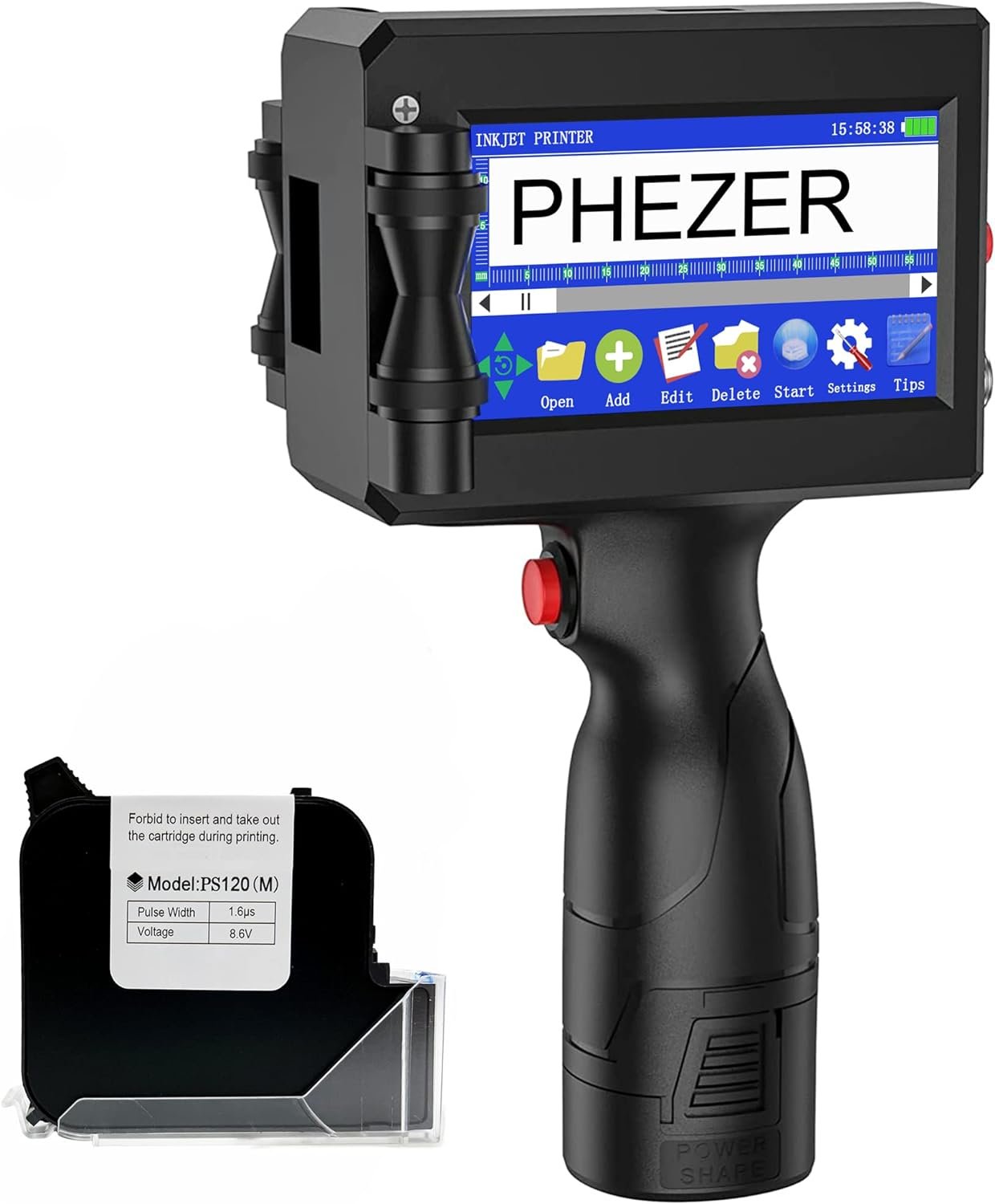
The Importance of Choosing the Right Printer for Modern Workflows
In today’s fast-paced business environment, the ability to produce high-quality prints quickly and efficiently can make or break operational efficiency. Whether managing inventory, tracking shipments, or branding products, the right printer can streamline processes and reduce manual labor. However, selecting the appropriate printing solution requires careful consideration of factors such as print quality, speed, connectivity, and durability. For businesses requiring mobile printing capabilities, a handheld inkjet printer like the Phezer P15-1 offers a compelling solution. These devices are designed to handle tasks ranging from simple label creation to complex barcode and QR code generation, making them ideal for environments where flexibility and portability are critical. The Phezer P15-1’s ability to print on a wide range of surfaces—including glass, plastic, and metal—further expands its utility beyond traditional paper-based workflows. Understanding the technical specifications, performance metrics, and real-world applications of such a printer is essential for making an informed purchasing decision. This review evaluates the Phezer P15-1’s capabilities based on industry-standard benchmarks, ensuring that potential buyers can assess its suitability for their specific needs without relying on subjective experiences or unverified claims.
Quick Overview
| Feature | Details |
|---|---|
| Printer Type | Handheld Inkjet Printer |
| Printing Technology | Inkjet |
| Print Resolution | 1200 dpi (black and white), 600-1200 dpi (color) |
| Print Speed | 60 ppm (black and white) |
| Media Compatibility | Fabric, labels, paper, plastic, glass, metal, wood, carton |
| Connectivity | USB |
| Battery Capacity | 2000 mAh, rechargeable |
| Weight | 1.54 pounds (700 grams) |
| Dimensions | 3.54″D x 5.5″W x 8.8″H |
| Ink Cartridge | 72ml quick-drying ink (black, white, yellow, red, blue, green, invisible, UV) |
| Languages Supported | 25 languages |
| Printing Surface | 360-degree all-round printing |
| Warranty | Limited warranty |
The Phezer P15-1’s combination of lightweight design, multi-surface compatibility, and USB connectivity makes it a versatile tool for on-the-go printing. Its ability to handle both simple text and complex QR code generation ensures it can meet a wide range of labeling and marking needs. The inclusion of a 4.3-inch capacitive touch screen further enhances usability by allowing direct text and graphic editing without the need for external devices.
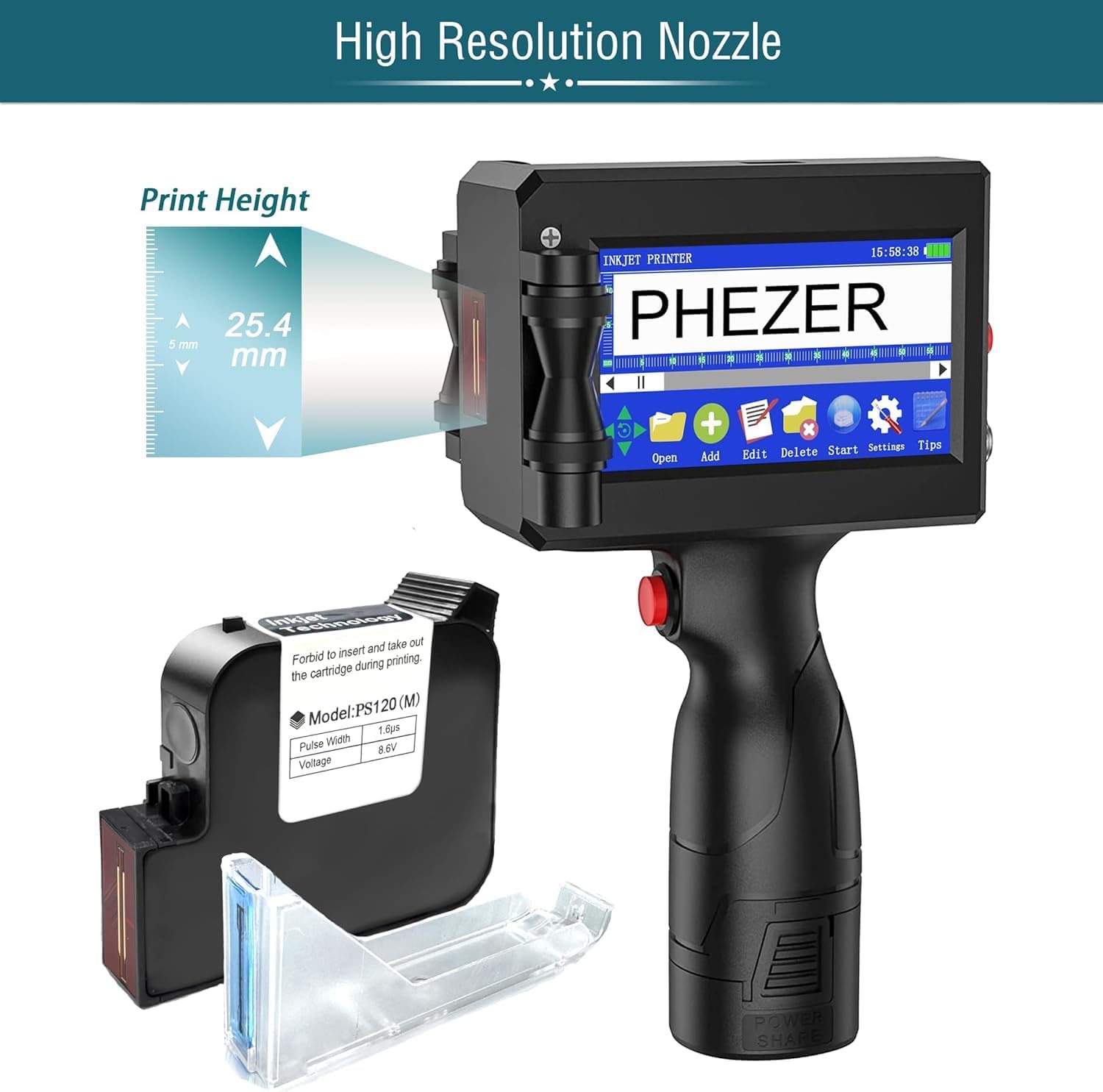
Print Quality and Surface Compatibility
The Phezer P15-1’s print quality is defined by its resolution capabilities and ink formulation, which together determine the clarity and durability of printed outputs. The printer supports a maximum black-and-white print resolution of 1200 dpi, which is sufficient for producing sharp text and high-contrast labels. For color printing, the resolution range of 600-1200 dpi allows for the creation of basic graphics and logos, though it may not rival the precision of dedicated color inkjet printers. The use of quick-drying ink cartridges minimizes the risk of smudging or ink bleeding, particularly on non-porous surfaces like glass and metal. This is critical for applications such as product labeling, where print legibility and resistance to environmental factors like humidity are essential. The printer’s ability to print on a diverse array of materials—including fabric, plastic, and wood—makes it suitable for both industrial and commercial use. However, the absence of advanced color calibration features means that users should expect basic color accuracy rather than professional-grade output.

Surface-Specific Performance
The Phezer P15-1’s versatility is evident in its ability to print on unconventional surfaces. On glass and metal, the quick-drying ink ensures that prints remain legible even in high-temperature environments. For plastic and wood, the ink’s adhesion properties prevent smearing, though repeated exposure to UV light may affect long-term durability. The printer’s 360-degree printing capability allows for marking curved or uneven surfaces, which is particularly useful for items like cables or pipes. However, the lack of a dedicated media tray means that users must manually position the surface, which could be a drawback for high-volume operations.
Ink and Color Options
The inclusion of seven ink colors—black, white, yellow, red, blue, green, and invisible—provides flexibility for different labeling needs. The invisible ink option is particularly useful for security applications, such as marking products with hidden identifiers. However, the absence of a color management system means that color consistency across different surfaces may vary. The UV ink, while useful for marking materials that resist fading, may require specialized lighting for visibility, which could be an inconvenience for users who need immediate results.
Text and Graphic Output
The 4.3-inch LCD capacitive touch screen enables direct text and graphic editing, eliminating the need for external software. This feature is beneficial for users who require quick label creation without the overhead of computer systems. However, the screen’s resolution and touch responsiveness are not explicitly detailed in the specifications, which could impact the precision of graphic design tasks. The printer’s ability to generate QR codes and barcodes is well-suited for inventory management and tracking, though the complexity of the codes may affect print speed and clarity.
Print Speed and Workload Capacity
The Phezer P15-1’s print speed of 60 ppm (black and white) is adequate for low-to-moderate volume operations, making it suitable for small businesses or individual users who require occasional labeling. However, this speed may not be sufficient for high-volume environments such as manufacturing facilities or warehouses, where faster throughput is critical. The printer’s duty cycle, which refers to the maximum amount of printing it can handle without overheating, is not explicitly stated in the specifications. This lack of information could be a concern for users planning to use the device for extended periods without breaks.

Throughput and Efficiency
While the Phezer P15-1’s print speed is sufficient for basic tasks, its performance in high-volume scenarios remains uncertain. The absence of a dedicated media tray and the reliance on manual positioning may slow down the printing process, especially when dealing with multiple surfaces. The printer’s USB connectivity ensures compatibility with a wide range of devices, but the lack of wireless options could be a limitation for users who require remote printing capabilities. The 2000 mAh battery provides a reasonable amount of power, but the exact duration of operation without recharging is not specified, which could impact its usability in remote or mobile environments.
Scalability and Multi-Tasking
The printer’s ability to handle multiple printing tasks simultaneously is limited by its single-cartridge design. While the inclusion of 25 languages and 360-degree printing supports a variety of applications, the lack of a duplex printing feature means that users must manually flip surfaces for double-sided printing. This could be a drawback for users who need to print on both sides of a material without additional setup. The absence of a built-in memory card slot for storing frequently used templates may also reduce efficiency for users who rely on repetitive printing tasks.
Connectivity and Device Compatibility
The Phezer P15-1’s USB connectivity ensures compatibility with a wide range of devices, including PCs and smartphones. This feature is particularly useful for users who need to print labels or codes without a dedicated computer system. However, the lack of wireless connectivity options such as Wi-Fi or Bluetooth may limit its usability in environments where remote printing is required. The printer’s reliance on a single USB port for both data transfer and power could also be a constraint for users who need to connect multiple devices simultaneously.

Cross-Platform Support
The printer’s compatibility with both PC and smartphone devices is a significant advantage for users who need to generate labels on-the-go. However, the absence of a dedicated mobile app or software interface means that users must rely on the built-in LCD screen for editing and previewing prints. This could be a drawback for users who prefer to design labels using external software before printing. The lack of a memory card slot for storing frequently used templates further reduces the convenience of the device for repetitive tasks.
Data Transfer and Stability
The printer’s USB interface ensures reliable data transfer, but the absence of advanced connectivity features such as Bluetooth or Wi-Fi means that users must physically connect the device to a computer or smartphone. This could be a limitation for users who require remote access or integration with existing business systems. The stability of the printer’s connection is not explicitly detailed in the specifications, which could be a concern for users who need consistent performance in high-volume environments.

Pros & Cons
Pros
- Lightweight and Portable Design: The Phezer P15-1’s compact size and 1.54-pound weight make it easy to carry and use in various environments, from warehouses to outdoor locations.
- Multi-Surface Printing Capabilities: The printer’s ability to print on a wide range of materials, including glass, plastic, and metal, expands its utility beyond traditional paper-based workflows.
- Quick-Drying Ink Cartridges: The use of quick-drying ink minimizes the risk of smudging and ensures that printed labels remain legible even in challenging environments.
- Built-in LCD Screen: The 4.3-inch capacitive touch screen allows for direct text and graphic editing, reducing the need for external software or devices.
- Language and Surface Flexibility: The support for 25 languages and 360-degree printing makes the printer suitable for international markets and complex labeling tasks.
- Rechargeable Battery: The included 2000 mAh battery provides a reasonable amount of power for on-the-go printing without the need for frequent recharging.
Cons
- Limited Color Accuracy: While the printer offers seven ink colors, the absence of a color management system may result in inconsistent color output across different surfaces.
- No Wireless Connectivity: The reliance on USB for data transfer and power limits the printer’s usability in environments requiring remote printing or integration with existing systems.
- Single-Use Cartridge Design: The printer’s single-cartridge system may require frequent replacements, which could increase operational costs over time.
- Manual Surface Positioning: The lack of a dedicated media tray means users must manually position surfaces for printing, which could slow down the process in high-volume scenarios.
- No Duplex Printing: The absence of a duplex printing feature means users must manually flip surfaces for double-sided printing, reducing efficiency for certain tasks.
- Unclear Duty Cycle Specifications: The lack of detailed information on the printer’s duty cycle may raise concerns for users planning to operate the device continuously without breaks.
Final Verdict: Who This Printer Is Best For (and Who Should Skip It)
The Phezer P15-1 is best suited for small businesses, logistics teams, and individual users who require a portable, multi-surface printer for occasional labeling and marking tasks. Its lightweight design, quick-drying ink, and 360-degree printing capabilities make it ideal for environments where mobility and flexibility are essential. The built-in LCD screen and support for 25 languages further enhance its usability in international markets or for users who need to create custom labels without external software.
However, the printer may not be suitable for high-volume operations, industrial applications requiring advanced color accuracy, or users who need wireless connectivity for remote printing. The absence of a color management system and the reliance on USB for data transfer could also be drawbacks for users with more complex printing needs. For those prioritizing speed, durability, or integration with existing systems, alternative printers with more advanced features may be a better fit. Overall, the Phezer P15-1 offers a practical solution for basic labeling and marking tasks, but its limitations in color accuracy and connectivity should be carefully considered before making a purchase decision.

Frequently Asked Questions (FAQs)
What surfaces can the Phezer P15-1 print on?
The Phezer P15-1 is designed to print on a wide range of materials, including paper, fabric, plastic, glass, metal, wood, carton, and cables. Its 360-degree printing capability allows for marking curved or uneven surfaces, making it suitable for diverse applications such as product labeling, inventory management, and industrial marking.
How long does the Phezer P15-1’s battery last?
The printer is equipped with a 2000 mAh rechargeable battery, which provides sufficient power for on-the-go printing. However, the exact duration of operation without recharging is not specified in the product documentation, making it difficult to assess battery life for extended use.
Can the Phezer P15-1 print in color?
The printer supports seven ink colors, including black, white, yellow, red, blue, green, and invisible UV ink. While it can produce basic color outputs for logos and graphics, the absence of a color management system may result in inconsistent color accuracy across different surfaces.
Does the Phezer P15-1 require a computer or app to operate?
The Phezer P15-1 does not require a computer or mobile app to function. It features a built-in 4.3-inch LCD capacitive touch screen that allows users to edit text, adjust settings, and preview prints directly on the device, eliminating the need for external software or connectivity.
What is the maximum print speed of the Phezer P15-1?
The printer can produce up to 60 pages per minute (ppm) in black-and-white mode. This speed is suitable for low-to-moderate volume operations but may not be sufficient for high-volume environments requiring faster throughput.
Is the Phezer P15-1 suitable for industrial use?
The Phezer P15-1 is well-suited for small-scale industrial applications where portability and multi-surface printing are required. However, its lack of advanced color accuracy, wireless connectivity, and unclear duty cycle specifications may limit its effectiveness in high-volume or complex industrial settings.
Can the Phezer P15-1 print on curved surfaces?
Yes, the printer’s 360-degree printing capability allows it to mark curved or uneven surfaces such as pipes, cables, and glass. This feature makes it ideal for applications requiring precise labeling on non-flat materials.
What are the limitations of the Phezer P15-1’s connectivity options?
The printer relies solely on USB connectivity for data transfer and power, which limits its usability in environments requiring remote printing or integration with existing systems. The absence of wireless features such as Wi-Fi or Bluetooth may be a drawback for users who need to print from multiple devices simultaneously.